

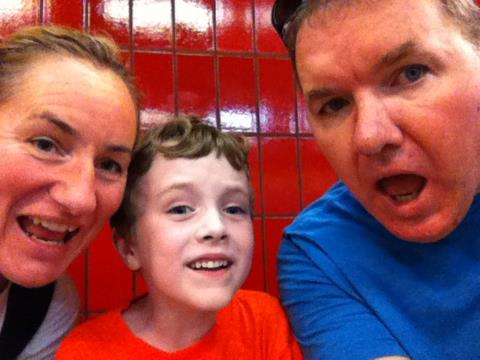
 Nick is getting better. Gains started six months ago when we made what my husband, a golfer pre-Autism, calls a ‘course-correction’, and changed the direction of Nick’s treatment.


In January, the month before we made these changes, I was feeling pretty blue about Nick’s progress. I was starting to try to digest even part of the idea that we may not get that far with bio med, that we may have to accept things as they are for Nick. I didn’t want to, and at only seven years old, it felt too early to be giving in. But after five years of trying so many different interventions and seeing so little benefit, I began to wonder if I was being unrealistic to stay hopeful. Doctors were beginning to refer to Nick as a “tough nut,” which I interpreted to mean “non- responder.” “Tough nut” was as painful to hear as the diagnosis of Autism itself, because it meant his doctors were running out of ideas. Maybe I should believe them, I wondered?
I have a really hard time changing providers. I tend to like them as people and I feel a sense of loyalty for how hard they are trying to help Nick even when we aren’t seeing results. So it’s really hard for me to leave. If you’ve tried a bazillion things and your child isn’t getting any better, you are in good company. There are loads of kids out there who, despite heroic efforts by their parents, aren’t getting a whole lot better. I was beginning to wonder if Nick was one of those kids. Maybe his Autism wasn’t going to budge.
If a genetic test had pinpointed a specific deletion or anomaly resulting in Nick’s Autism, I might have done more grieving upfront, made my mind up to accept our future and gotten on with it. We had the newest genetic Micro-Array testing done at the Cleveland Clinic under the Mitochondrial Specialist, Dr. Natowicz in 2011 and Nick’s genes did not show any differences or markers for anything abormal. If Nick’s Autism had a genetic origin maybe my mood about the whole thing would be different? Maybe I wouldn’t look at him every day like a child who was injured. Would I say to myself, “This is who he is, this is how he came into this world, get over it Alison and get on with creating a great life for this kid?” Instead, I look at Nick every single day like the vaccine injury just happened. I am still waiting for him to come back, like the missing child on the milk carton. I don’t know if he will come back or if I’ll only get a part of him back. That’s why my grief is so incomplete.
When Nick received the diagnosis of Autism in 2006, I viewed it as a starting point rather than an end point. I thought, “Well, they’ve given me terrible news. Let’s see what we can do about this. Let’s see how quickly we can turn this around.” At the time, my daughter was six and we spent a lot of time watching a video of the first television broadcast of Cinderella with Julie Andrews singing, “Impossible things are happening everyday.” That became my mantra.

So I grieved a little bit and then got my ass in gear to help him. Every year, I have grieved the things that Autism has stolen from us, but I have tried not to look too far ahead. I often tell people that I am fueled to help Nick recover because I am being chased down the street by a poorly-run group home, which is my greatest fear for his future. Despite my fear, I can’t embrace that yet. Living in this state of incomplete grief is painful in its own right. It’s the not-knowing that is killing me. This makes me think of a few lines from the poet Ranier Maria Rilke:
‘Live your questions now, and perhaps even without knowing it,
You will live along some distant day into your answers.’
Hmmmm…fuck you Rilke, I need to know.
Right around the time Nick was diagnosed, a dear friend lost an eight-month-old baby girl to Leukemia. I was on the phone with her one night while I was giving Nick a bath and she said to me, “This is hard for me to say and it will be hard for you to hear but these words will be important for you to remember every day: He is alive.” This was one of the most powerful gifts I have been given in my life.
So, yes my sweet boy in the tub was alive but this wasn’t exactly “living” for him or us, so I got moving like a crazy person to improve the situation. I have always focused on the word “better” rather than “recovery” for two reasons; I get sick of the argument “but is he really recovered?” often by people who don’t have a child on the Spectrum and the second reason is more vulnerable for me to reveal. It’s because I haven’t known deep in my heart if it was possible for my son. I’m telling the truth. “Better” I could promise; “recovery” felt like trying to pluck a star down from the sky for him.
Last winter, I changed several of Nick’s providers, tried some new types of treatment, and we have hit on a combination that is clicking for him. It feels like we are finally on track and building momentum. I chose the combination of things we are doing based on a hodgepodge of thoughts: recommendations from smart moms , a provider I trust to her core, a little bit of “what the hell, we’ve done everything else,” and something deep and intuitive I can’t explain. It is working and my careful optimism has been blasted out of the way by, “Holy Shit! This kid is getting BETTER!” In six months, Nick has cut his ATEC score in half from a 67 to a 36! What I’m coming to understand is that “non-responder” really means not responding to what a certain provider has to offer or not responding to a specific protocol or intervention at a given point in recovery. “Non-responder” does not refer to the potential of the child, but to the potential of the protocol.
The risk in Nick’s improving is that I’m not just focusing on the gain he made today (eating ice cream with a spoon instead of his hands), I’m counting on the fact that because he is improving, he will continue to, and we can forget about that group home. Dangerous, because part of me is trying to get used to the idea of the group home so I won’t fall apart if I have to face it down the road. I’ve always worried ahead. It’s how I take care of myself. So what now? How do you risk hope and grieve responsibly at the same time?
With the diagnosis of Moderate Autism, Nick has been cloistered in a very separate and sheltered universe. Now that he is doing so much better, the question of integration at school is going to come up at his fall IEP meeting and my anxieties are beginning to soar. Will the other kids be kind to him? Will he be able to take in any of the mainstream academic work? Will he be bullied? I have to keep reminding myself that this is the problem I wanted to have – like trying to figure out how you will spend the money if you win the lottery.
I’ve always been hopeful about Nick’s ability to get better. I’ve carried an unwavering optimism deep in my heart from the beginning of this journey. If you’d asked me what it was based on, all I could tell you was some kind of faith, in what I don’t even know. But that quiet, internal drumbeat of optimism didn’t jibe with “non-responder.” It didn’t feel right to me in a very instinctive way. I don’t know if the current path we’re on will continue to lead him towards recovery. I don’t know how long the gains will keep coming. My instincts tell me we are on a good course, but only time will tell for sure. If we lose this trail though, I am confident now that we will be able to risk changing course again and try a new one. I’m also firm about sticking to my optimistic instincts and choosing to risk hope.
Apparently Nick is a “Responder!”
~Mama Mac
For more posts from Mama Mac, please click here.



 TMR Book
 Black TMR T-shirts (Mens)
 Black TMR T-Shirt (Ladies)

I know I’m seeing this from a different perspective than many but I was very affected by the idea of the poorly run group home.
I am a woman in my early thirties who should undoubtedly have been diagnosed as high functioning autistic when I was a child. I am married to a man slightly younger than myself who is lower functioning than I am. He can panic if asked to make a decision, needs carefull lists in order to follow steps, is so easily distracted that the only way to have a conversation is to turn off the radio, tv, etc and he can still get distracted by what’s happening outside the window. With great luck and planning he works in the food service industry and makes a decent wage but would have difficulty getting a decent job again. He depends on me much like your sons/daughters do yourselves.
I push, push, push to get money into the bank and retirement handled because I fear what would happen to him if I were gone. I don’t want him to be one of the people who struggle through middle age and then have nothing, dependent on others as his body wears out.
I know we are higher functioning then some, but our problems in many ways are the same. An uncertain future.
Loved this whole thing!! My daughter was diagnosed at 2 1/2 and she just turned 19. Lots of different therapies, plane trips, car trips, tests up the wazoo, etc., etc, etc. You are so right. If you are not going forward, change it up. I would always have a Plan B or C or D or F in my back pocket (while working on the current therapy). Through all these years, we had two major WOWs. The first was Methyl B-12 with Glutathione (from our pediatrician who I pestered for eight years until he finally went to an autism conference!) at 10 years old and then when she was almost 13 we tried Sequential Homeopathy with Lindyl Lanham. Out of all the therapies (way too many to list) this was the combo that worked for her. We still are with Houston and continue to see progress - slowly better and better. Slow is ok with me. She is not fully recovered — I would say about 75%. My goal was full recovery and we worked our butts off to get her to the point where she makes many of her own choices now. She is maturing and growing up in her own way. So, her recovery did not look like I planned in my head for years. We got something else and I am profoundly grateful that we have been blessed to see what an imaginative, happy, thoughtful young woman she has come to be. Doing the happy dance for Nick. Keep Going!!
“If Nick’s Autism had a genetic origin maybe my mood about the whole thing would be different?”
Perhaps I can throw a little cold water on the “genetic origin of autism” or the less ominous “genetic proclivity for autism”. Both are complete and total bs.
Even if there were some sort of genetic predisposition for autism what is important is how the gene is expressed. How we eat, the drugs, read “vaccines” take and many other environmental factors determine how our genes are expressed.
A new science has developed over the last 15 years or so. the science of EPIGENETICS. IMO anyone dealing with the ASDs needs to take the time to understand the basics of epigenetics, how our genes are expressed.
This understanding of epigenitics may put his mind at ease and to allow him to soldier on with the full knowledge that just as man put the ASD into your child so man often can take it out and genetics have very little to do with either putting it in or taking it out
“In his book, The Biology of Belief, Doctor Lipton explains the foundation of epigenetics, and how the true secret to life does not lie within your DNA, but rather within the mechanisms of the cell membrane. In this way – which is contrary to conventional medical science – it is actually the cell’s membrane — operating in response to environmental signals picked up by the membrane’s receptors — that control the “reading” of the genes inside. This is very relevant to the world that we are in because we have to take back a belief that we have power over our lives. Because our current perception is that we are victims, and since perceptions control life, if you believe you are a victim, you become a victim. When we change our perception.”
“Epigenetics is unraveling a continuous cross talk between our genetic profile and the environment. Indeed, genome is much more “flexible” than previously thought and such flexibility underscores the relevance of “good eating” for maintenance of good health. Future nutritionists will have to face the challenge of elucidating the mechanism of nutrition-induced epigenetic changes during pre and post-natal life, to optimize nutritional interventions in a “personalized” perspective.” Genes & Nutrition
“Traditionally, we understand that individual phenotypes result primarily from inherited genetic variants together with environmental exposures. However, many studies showed that a remarkable variety of factors including environmental agents, parental behaviors, maternal physiology, xenobiotics, nutritional supplements and others lead to epigenetic changes that can be transmitted to subsequent generations without continued exposure. Recent discoveries show transgenerational epistasis and transgenerational genetic effects where genetic factors in one generation affect phenotypes in subsequent generation without inheritance of the genetic variant in the parents. Together these discoveries implicate a key signaling pathway, chromatin remodeling, methylation, RNA editing and micro-RNA biology. This exceptional mode of inheritance complicates the search for disease genes and represents perhaps an adaptation to transmit useful gene expression profiles from one generation to the next.” Human Molecular Genetics
In four weeks, a high-glucose diet was found to shut down the gene that creates digestive enzymes. Food wouldn’t move through the digestive tract, and it couldn’t be absorbed.” Molecular Biology Reports. 2010 Apr; 37(4):1867-1874. Note this is a great example of epigenetics in action, simply avoid the sugar and your epigenome will not be rearranged negatively
Great Stuff! Loved reading this
Alison,
Have you tried Therapeutic Listening at all? http://www.vitallinks.net
Also…this is a great camp that happens once a year, http://www.campavanti.com
In addition, I have a friend who has had great success with the GAPS diet:)
Dori:)
Hi Alison,
I wonder if you have read ‘Impossible Cure’ by Amy Lansky? It may be another option for you to try someday:)
We love homeopathy in our house! Loved Amy Lansky’s book!!
Thank-you for sharing your story. You summed what I have been feeling lately. We too have hit a brick road, with our child, she feels like a ‘non-responder’. Nothing seems to be working to get my child off the plateau she is on right now. I feel as if I am sinking, yet still trying to fight, however I have lost my path. Not sure where to turn too. What should I try, what will make her respond, and come back to us. Is there anyway I can contact you?
Sincerely,
Sania
Sania, send me a private message on facebook.
Well there ya go… I was just feeling down in the dumps because of our plateau. Your post has me renewed.
I read this out loud to Bill after dinner tonight. My voice choked all the way through. The most chilling part to read aloud….I am being chased down the street by a poorly-run group home….it’s in our nightmares. You and your family are us a few years back. Knowing they were wrong, that our boy WAS IN THERE! We were both full of tears for your family when I finished reading. We are still running from the group home but continue to push, push,push. We are so very lucky that our Nick is the youngest of 3, the olders will keep him safe even if it has to be a group home. Still working toward the miracle.
So nice to hear! Hope is so important.
Totally crying…love Nick! Love you! He’s doing soooo incredible, looks fantastic, and so much healthier….you and that kid inspire me every freaking day, Al <3 xo
Waiting for him to come back…Oh how you pulled at my very soul. I’m waiting too, and I’m so joyful that you are seeing progress! Our children deserve results from ALL that we put them through, and so do we. I remain ever hopeful with you! Xoxoxoxoxox!!!
Hi Allison,
I am so happy for you. The tough Moms crack the nut………..full speed ahead:) His smile says it all:)
Hey Mamma Mac, my son’s CGH micro-array showed nothing either. Neither did the fragile X test. It was the MitochondrialDNA and MitoNuclear :whole genome” testing that lit up like a Christmas tree. massive mitochondrial damage and they can pin point what & where. I reccommend that testing. Not cheap, but gets down to the nitty gritty. Send me a note at my e-mail, I can give you all the goods.
Hi Rainmom, how can I reach you? I want to find out more about this testing.
yeah , me too, please email me the info, My son hasnt responded that much….not as much as I would hope
May I get an email too?
Me too I would like to know what test helped you with Mito as I have been searching for one.
Hi, Rainmom-how can I reach you? I’d like to learn more about the testing you described. I’m at [email protected].
Thanks!! Janet
Me too can you email me [email protected]
Hi Rainmom, Would love to hear more about the testing. How to reach you? Thank you!
His face says it all. Beautiful <3
This is fantastic! Your perseverance is remarkable. I feel like I’m surrounded by parents who go “light on gluten” for a week and then throw in the towel on biomed. Nick is yours for a reason. You are a light in the darkness for many families. Rock on!
This is so wonderful. Thank you for sharing.
Alison, you could have written Will’s story in this post as well. Will too had the micro array genetic testing along with a few other tests in early 2011 at Children’s Hospital. No problems whatsoever were discovered.
I too feel like i have no choice but to forge ahead; always researching and looking for the next level of improvement for him.
So very happy for Nick. So very thankful for you too.
That’s great news. Nick looks so happy in the pictures you see that he is doing much better. Would mind sharing what the treatment was? What course change in his treatment made the biggest difference? Starting to feel like we hit a wall here. this gives me hope. Thanks
just send me a private message on facebook and we can talk about it! Thanks for your kind words everybody!
okay, thanks
Thanks for the fabulous post. I am in the same boat as my 9 yr old daughter is getting better after 6 months of the Brain Balance program. In exactly 5 days, she will be starting the 3rd grade fully mainstreamed without an aid. (But with resource room help.) It is a place I have looked forward to for MANY years, yet the anxiety is killing me. Will she be able to handle it? Will the kids be nice to her? Will she script the entire day? The worries are endless, so for now, I just enjoy the moment. This moment I have secretly feared would never come, but somehow…..by the grace of God, we are here.
Never give up, never surrender! So happy for you and proud of your perseverance. Our son is now 17, and while we have seen tons of improvements since beginning biomed at age 10, there are still things that I’d like to ameliorate. Sound sensitivity and auditory processing problems continue to be his core deficits. Also, I’ve retained an attorney to do battle with my school district over lackluster transition services. I feel a little guilty, but since my husband had open heart surgery at 50, and I had breast cancer at 51 (both within the past two years), I’ve had to shift my priorities and focus to our own health. But I do intend to hold on tight to our dreams!
Beautifully written: heartfelt and hopeful.. So glad you found the right formula for Nick!
Ana
“like trying to figure out how you will spend the money if you win the lottery.”…ahhh thats pure Alison right there…Too good. I’ve seen you work your ass off to help Nick, and I am beyond thrilled you hit on a combo that seems to be working for him. Just keep swimming! Love ya MM….
I love you guys! We just keep plugging away don’t we. If anyone wants to ask specific questions about interventions, private message me on facebook and we can talk about it. Here’s to never giving up!
There is so much to chew on with this post. The concept of incomplete grief, the unwillingness to accept a “tough nut” diagnosis. The uncertain future. The going with your gut which is always our greatest asset as parents.
“I am being chased down the street by a poorly-run group home”
May it never catch you.
Pingback: AnneDachel.com » Blog Archive
Mama Mac ~~ u literally took the words right out of my mouth today. Is there any way I can contact u directly? I have a 9 yr old ‘tough nut’ daughter that I’d love to speak to u about. Thanks so much, Lisa
This is just pure bliss Alison! I am so happy for Nick, you and your family Wishing you continued success and progress!
Against all odds. Despite the official claim that there is no hope and all you can do is behavioral intervention—”This kid is getting BETTER!”
More proof that moms SHOULD NEVER GIVE UP.
This is just what I needed today, since today is my daughters 6th Birthday and I feel more depressed and cheated on, especially since I feel she hasn’t been progressing in the last 6 month. Your post resonates with my feelings so much it’s incredible!
Alison, you’ve written everything I’ve been hoping and fearing for almost 11 loooonngg years. But I still have that inner knowing that my son will respond and will get better. I’ll admit it’s freakin’ tiring to figure out the right combo.
Thank you for sharing.
“and that’s why my grief is so incomplete.” mamma Mac, you took every thought within my being and articulated it with the perfect analogies and details. The same drum beat lies with in me. Jules was dx in 2006 also. He is 6.5, and also been labeled a, “tough nut.”
I bought what I call a “cheesy plaque” from the clearance at Target in 2009 , when I got my ass in gear and we started biomed. It hangs alone on the wall in the living room and says, “everyday holds the possibility of a miracle.”
As I sit here having this cathartic cry, I am considering the balances we must teeter on through this whole thing. And with many many prayers, hope, determination, and fearlessness, I am confident our two “moderate” boys will one day be taxpayers.
keep on truckin’, celeste. you got this.
Hello,
thank you for info on Nick…
Is it possible for you to mention any of the things which are now working?
thks
We have been battling autism for only 8 months, and in that 8 months, we have seen 4 “DAN” docs. Right now we are seeing two at the same time, one is a homepath. Unlike you, I am wiling to switch…maybe too quickly? But what I do know is that in the 2 weeks since we started with homeopathy, I have seen the most changes in communication/speech. Two weeks of giant strides. I will stick with what I have for a while, but will always be looking for the next thing.
At autismone this year, one of the biggest messages I got was, “If something doesn’t feel right, stop it.” We came home and fired our speech therapist. What a relief.
I am so happy that things are going better for your son! I pray it will continue!
I love this SO much. GO NICK GO!!!!!!!!!!!!!!
“Non-responder” does not refer to the potential of the child, but to the potential of the protocol. Very profound words. Wish I had understood that earlier in this journey! Excellent post Alison. I can identify with all of it, down to my core. My optimism for “better” rarely waivers, nor can I pinpoint what drives it (That’s actually a bit of a lie, the daily check in with thousands of Warriors waking up for battle each and every morning certainly starts my engines, but the stamina through the 8 years of the chase is all me!). You are among one of those warriors that helped reprogram my gps not too long ago, and for that I am thankful.
What an inspiring post! I am still looking for that magical combination. But from your photos one can see how far Nick has come! And as for mainstreaming, in 1st grade I was amazed at parents who came up to me to tell me how much their child liked my on. At least when they are young they can be accepted and very different.
I love it! Thanks for sharing the hope:)
Hi Alison,
Thanks for this. I also have been battling this hope/grief thing and wondering if we’ve done all we can do. Thanks for the kick in the ass to keep going for not only my son’s sake but for his 6 sisters…so they won’t have to be burdened with him…instead of the dreaded group home.
I believe I tried calling you a while back about getting started with the mms protocol. Our son’s atec hasn’t budged for a year despite many different therapies. What have we got to lose?
Thanks again,
Anna